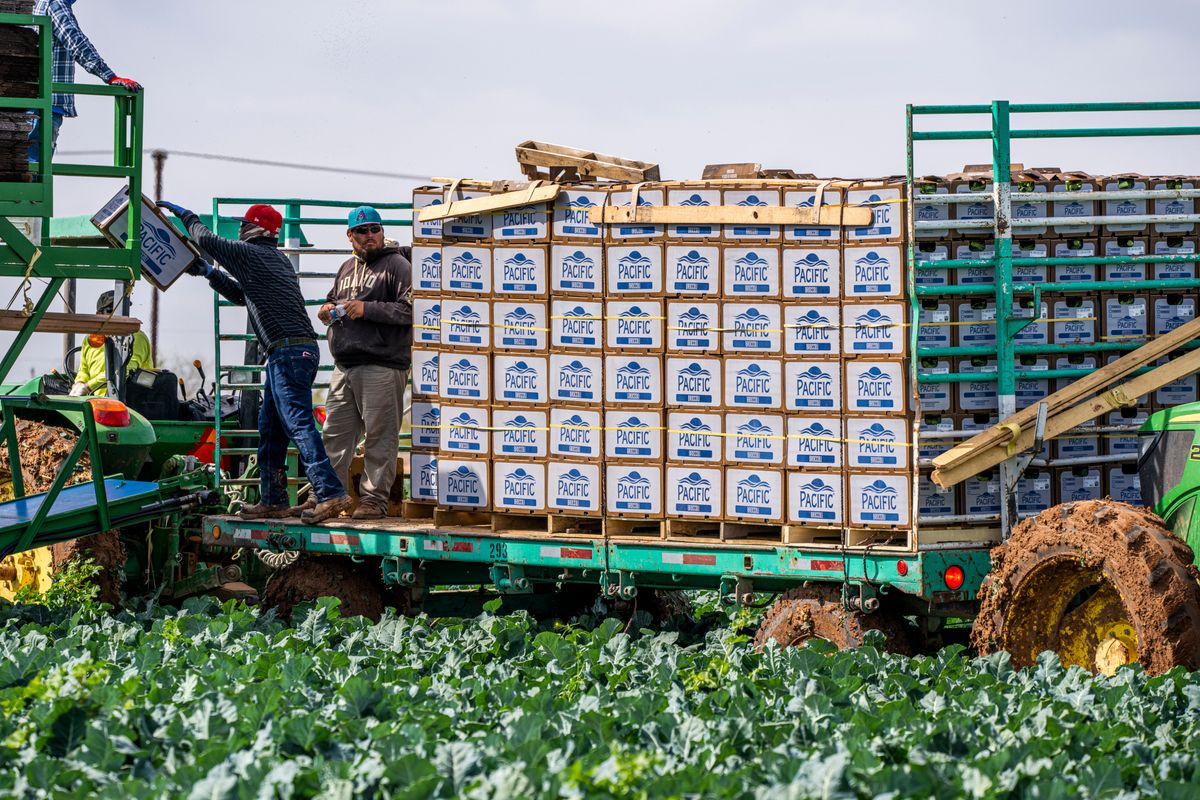
When people picture a traceability failure, they imagine it somewhere in the middle of the journey. A truck. A warehouse. A mislabeled pallet three states away.
The real break is almost always at the very beginning.
It happens in the first mile — the earliest stretch of the supply chain, where raw product leaves the farm and enters aggregation. It's the least visible part of the chain, and it's where the origin trail most often goes cold before a single truck has left the yard.
The Chain Doesn't Start as a Line. It Starts as a Funnel.
A finished lot of produce rarely comes from one place. To fill an order at volume, a packer or aggregator pulls product from many farms at once — sometimes a handful, sometimes dozens — and combines them into a single, uniform lot.
That combined lot gets one lot number. One label. One identity. And from that point forward, it moves through the rest of the supply chain as a single unit.
But here's the problem: the moment those farms merge into one lot, the individual origins behind it can blur together. Six distinct sources become one anonymous "mix." If the paperwork at that handoff is manual, partial, or inconsistent — which across much of the industry, it still is — the link back to each specific farm is weakened or lost entirely.

Notice what happens after the merge in the diagram above. The colored trails — each a distinct farm — collapse into grey. The lot moves on to distribution looking perfectly clean, but the connection to its true sources has already snapped. The break didn't happen downstream. It happened at the first handoff.
Why the First Mile Decides Everything Downstream
This matters because traceability only works if it's unbroken. A chain that's pristine from aggregation to retail is still useless if the very first link is missing.
When contamination surfaces weeks later, investigators work backward — distributor, cold storage, packer — until they hit the merge point. And there, the trail forks into a dozen possible farms with no way to know which one. So the recall has to include all of them. Every farm that fed that lot gets swept in, whether their product was involved or not.
This is the hidden engine behind over-broad recalls: not a failure at the store, but an identity that was never captured at the source. The first mile is where a surgical recall becomes impossible before the outbreak has even begun.
More Suppliers, More Risk
Every operation wants supplier flexibility. More sources mean better pricing, more resilience, and the ability to fill orders when one region has a bad season. But flexibility has a hidden cost: every new supplier is another origin trail that has to be captured cleanly at the merge.
Add a supplier, and you don't just add a farm — you add another way for the first-mile record to break. A grower on a different system. A new certificate to verify. A fresh set of lot codes that may or may not line up with everyone else's. The more diverse your supply base, the more fragile that first handoff becomes — unless something is actively holding it together.
This is the paradox at the heart of modern sourcing: the same supplier diversity that makes an operation resilient also makes it harder to trace. The strength and the vulnerability come from the same place.
Fixing the Break at the Source
The solution isn't fewer suppliers. It's capturing origin identity at the exact moment of the merge — turning the aggregation point from where traceability breaks into where it's forged.
That means every incoming source is logged, verified, and linked to the combined lot as it's created — so the finished lot doesn't just carry a number; it carries the full record of every farm inside it. When that happens, the funnel stops erasing identity and starts preserving it.

Same farms. Same merge. Same combined lot. The only difference is that the origins were captured cleanly at the source — and now the entire chain downstream is traceable, because the first link finally holds.
Traceability Is Only as Strong as Its First Link
The industry has spent years focused on the middle and end of the supply chain — the trucks, the warehouses, the store shelves. But the data that everything downstream depends on is set in the first mile, at the messiest, least-visible handoff in the entire journey.
Get the first mile right, and every recall gets narrower, every audit gets faster, and every new supplier becomes an asset instead of a liability. Get it wrong, and no amount of downstream technology can reconstruct what was never captured to begin with.
ProduceX turns the first mile from your weakest link into your strongest. Our supplier intelligence captures and verifies origin at the moment of receiving — so every combined lot carries the full record of every farm behind it, and more suppliers never means more risk. See how ProduceX keeps the whole chain traceable from the very first handoff.