If you've felt like there's a new food recall in the headlines every single week this year, you're not imagining the feeling. Cyclospora in lettuce. Salmonella in jalapeños. Listeria in cheese. Eggs, blueberries, deli meat.
What you might be imagining is the crisis.
Because here's the number almost no one is reporting: food recalls in 2026 are not actually up. If anything, they're trending down.
The Myth: A Recall Epidemic
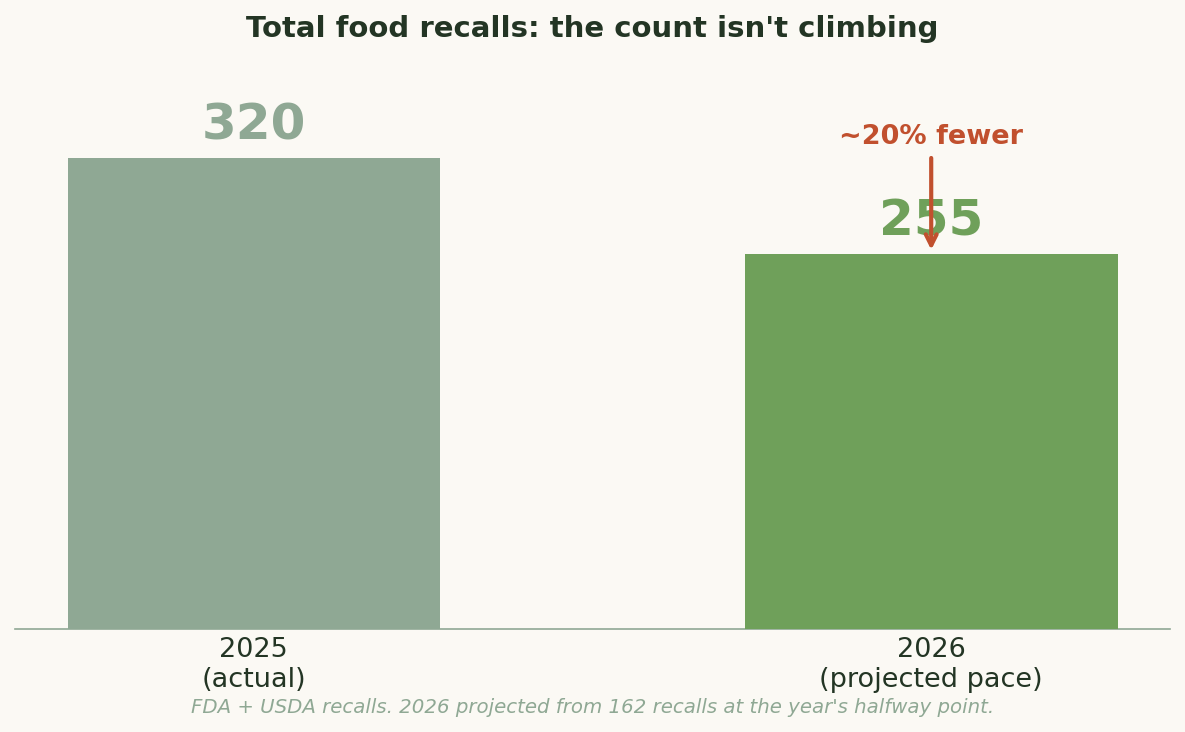
In 2025, the FDA and USDA issued 320 food recalls between them. By the halfway point of 2026, the count stood at 162 — almost exactly half of the prior year's total. If that pace holds, 2026 will finish around 255 recalls: roughly 20% fewer than 2025.
So if the raw number of recalls isn't climbing, why does it feel like the sky is falling? The answer is more interesting than the panic — and it comes down to four things that have nothing to do with frequency.
Why It Feels Like a Crisis: Four Real Reasons
1. Scale, not frequency. This is the big one. A handful of 2026's outbreaks have been enormous. The Taylor Farms iceberg lettuce recall, tied to a cyclospora outbreak, is linked to more than 17,000 illnesses. As food-safety expert Darin Detwiler put it: "A handful of very large recalls can expose far more consumers than dozens of smaller ones." A few massive recalls reach more people — and generate more fear — than a hundred small ones ever could.
2. Better detection is finding what used to stay hidden. This one is genuinely good news dressed up as bad. Advances like whole-genome sequencing now let investigators connect illness cases that, a few years ago, would have looked completely unrelated and never been linked to a common source. The result: more outbreaks get identified. More identified outbreaks can mean the system is working better, not that the food is less safe. More recalls does not automatically mean more danger.
3. Cascading recalls from a single source. Modern supply chains turn one contaminated ingredient into a cascade of headlines. When jalapeños from a single grower are implicated, the recalls ripple outward across dozens of downstream products — salsas, guacamole, prepared meals — under many different brand names. One failure at the source becomes twenty recall notices at the shelf.
4. Amplification. Intense media coverage and social sharing make every recall feel omnipresent. A recall that would once have been a small regional notice is now a viral national story. Perception compounds.
The Nuance: Don't Swing to "Everything's Fine" Either
Here's where the honest analysis refuses the easy answer in both directions. "Recalls aren't up" is true — but it is not the same as "there's nothing to worry about." Two data points keep it grounded.
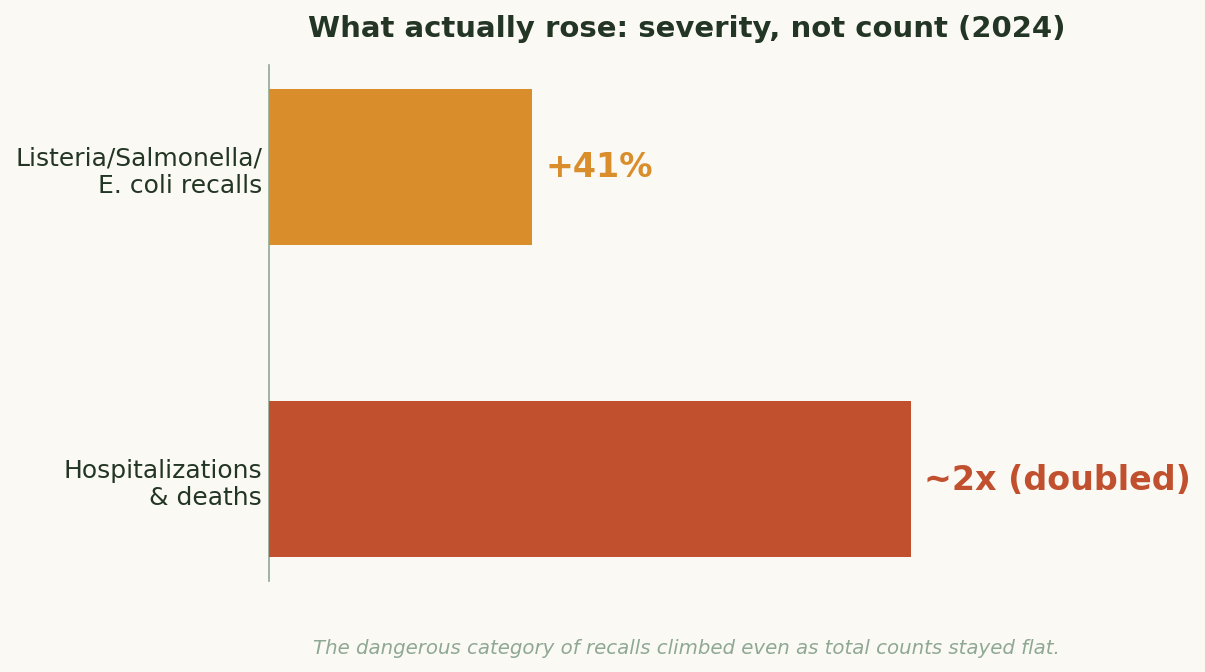
First, the recalls that matter most have been getting worse. In 2024, recalls tied to Listeria, Salmonella, and E. coli jumped 41% and accounted for 39% of all recalls — and, more soberingly, hospitalizations and deaths from foodborne illness roughly doubled. The total count of recalls is a poor measure of safety. Severity is the better one — and severity has been climbing.
Second, and more structurally, the system that catches these problems is being quietly weakened. Brian Ronholm of Consumer Reports describes food safety infrastructure as a "Jenga tower" — surveillance, inspections, traceability, and investigations stacked together. And, in his words, blocks have been pulled out: "budget cuts and layoffs; cuts to outbreak monitoring and surveillance; delays in implementing a traceability system." The instability doesn't show up in this year's recall count. It shows up in the resilience underneath it.
The Real Story: Scale, Detection, and the Fix
Put it all together and the "recall crisis" narrative is mostly wrong on the numbers but right about the anxiety. The genuine concerns aren't that we're seeing more recalls. They're that:
- Outbreaks are getting bigger, because supply chains are more concentrated — one source now feeds a huge share of the market.
- The dangerous recalls are rising in severity, even when total counts hold flat.
- The detection and traceability infrastructure is under-resourced, right when it matters most.
And here's what ties them together: all three point to the same answer — faster, more precise traceability. Speed of trace shrinks the scale of an outbreak, because the faster you find the source, the fewer people are exposed. Precision turns a cascade of blanket recalls into a single contained pull. And robust, digital traceability is exactly the "Jenga block" the system most needs reinforced.
The Bottom Line
The next time a wave of recalls dominates the headlines, resist both the panic and the shrug. The count isn't the story. The scale is. And the most powerful lever on scale — the thing that determines whether one bad lot sickens twelve people or seventeen thousand — is how fast and how precisely the industry can trace it.
Fewer, smaller, faster-contained recalls isn't a fantasy. It's what better traceability actually produces.
ProduceX exists to shrink the scale of the next outbreak — with lot-level traceability that finds the source in minutes, and surgical recalls that contain a problem instead of broadcasting it across dozens of brands. In a world where scale is the real risk, speed and precision are the real protection. See how ProduceX helps operators trace faster, recall narrower, and keep one bad lot from becoming a national headline.