
When people argue for traceability, they usually reach for stories. The outbreak that spread too far. The recall that swept in innocent growers. The weeks it took to find a source.
Those stories are real. But there's something more powerful sitting in plain sight, and almost nobody in the industry has read it: the FDA already calculated what traceability is worth — in dollars.
When the FDA finalized the Food Traceability Rule (FSMA 204), it was legally required to publish a Regulatory Impact Analysis — a full cost-benefit model. And when the agency proposed delaying the compliance deadline to July 2028, it published another. Together, these documents contain the closest thing we have to an official price tag on traceability. The number is striking.
The Headline: Nearly $1 Billion a Year
The FDA estimates that the Food Traceability Rule delivers approximately $968 million per year in benefits to the United States, against roughly $641 million per year in costs — a net benefit of about $327 million per year. Over a 20-year horizon, that's a present value in the range of $14 billion in benefits.
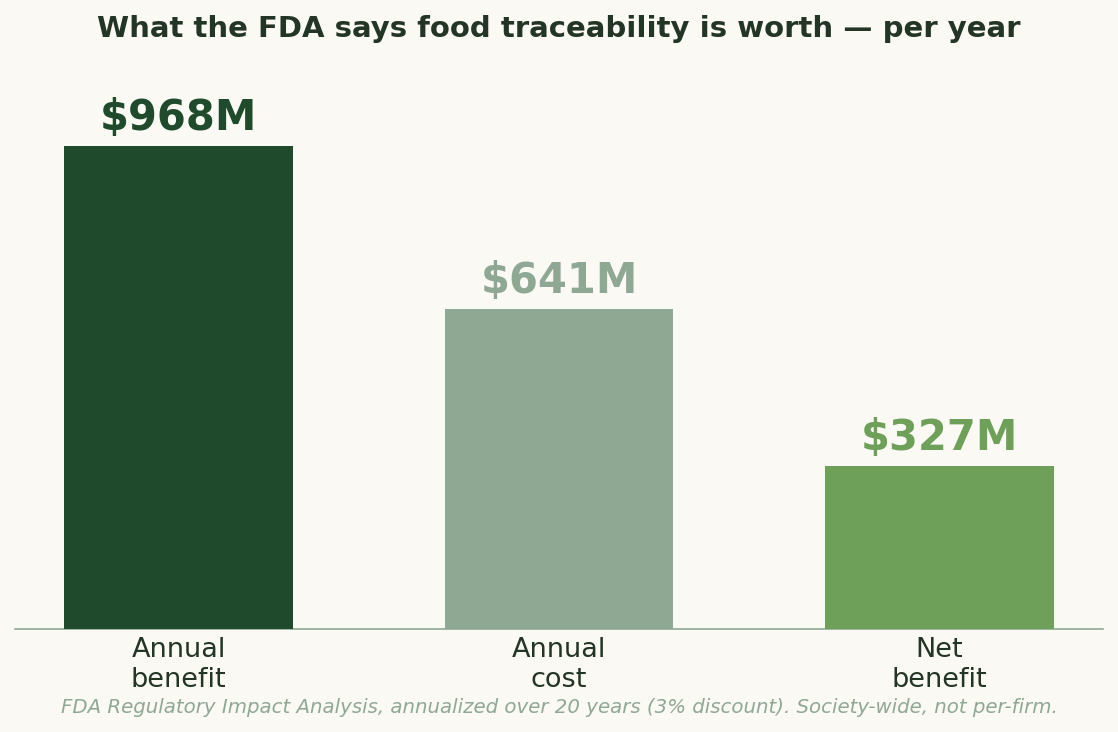
One caveat worth stating plainly, because credibility matters: these are society-wide figures — the total value across the entire U.S. food system, including public-health benefits like illnesses prevented. They are not a per-company savings estimate. But as a measure of the size of the problem traceability solves, they're the most authoritative number that exists.
Where Does the Value Actually Come From?
This is the part every operator should sit with. The FDA's analysis is explicit that the value of traceability comes from two specific sources — and both are things the industry has spent years underestimating.
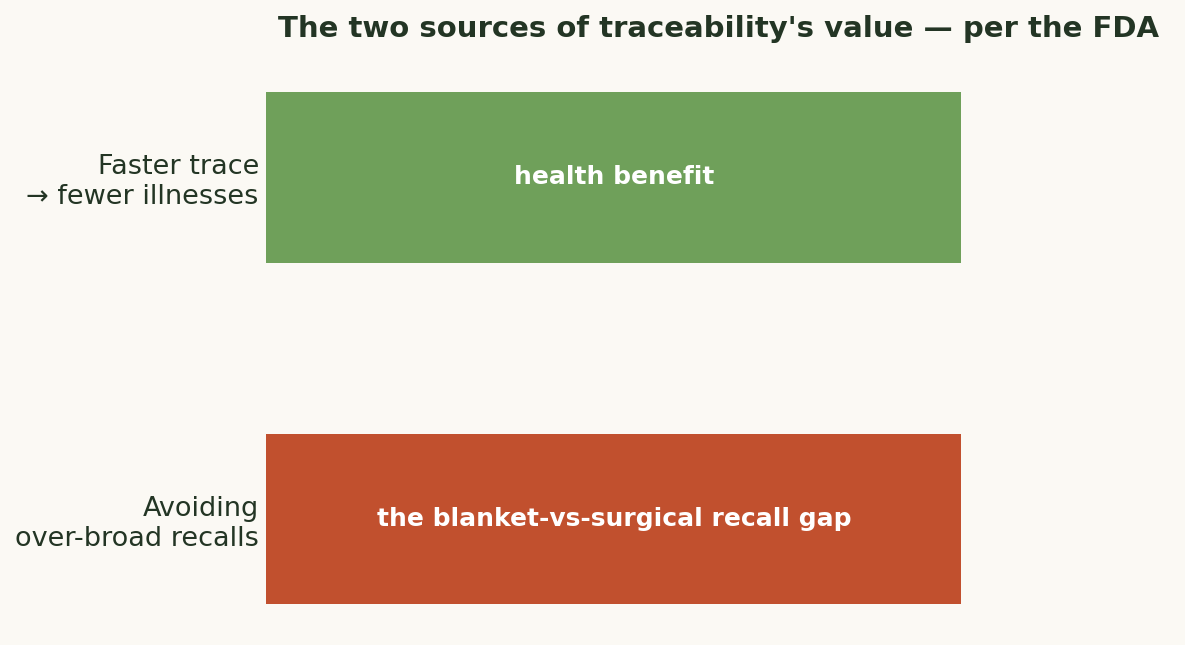
1. Speed of trace. In the FDA's words, traceability records "reduce the time that a contaminated covered food product is distributed in the market, which in turn leads to a reduction in foodborne illnesses and deaths." The faster you can identify and pull affected product, the fewer people get sick. Value is a direct function of trace speed.
2. Avoiding over-broad recalls. This is the one to underline. The FDA explicitly counts, as a benefit, "avoiding costs associated with conducting overly broad recalls and market withdrawals" — because better traceability lets industry "more rapidly and effectively trace food products that cause illnesses."
Read that again. The difference between a blanket recall and a surgical one — between destroying an entire product line and pulling a single implicated lot — is a benefit the U.S. government has formally quantified and put into a federal cost-benefit model. The precision of your recall isn't a nice-to-have. It's a line item in the FDA's economics.
The Cost of Waiting: A $1.3 Billion Gap
Here's where it gets pointed. When the FDA proposed pushing the deadline from January 2026 to July 2028, its economists calculated the cost of that delay: roughly $1.3 billion in foregone benefits — the health protections and recall savings the country gives up during those 2.5 years.
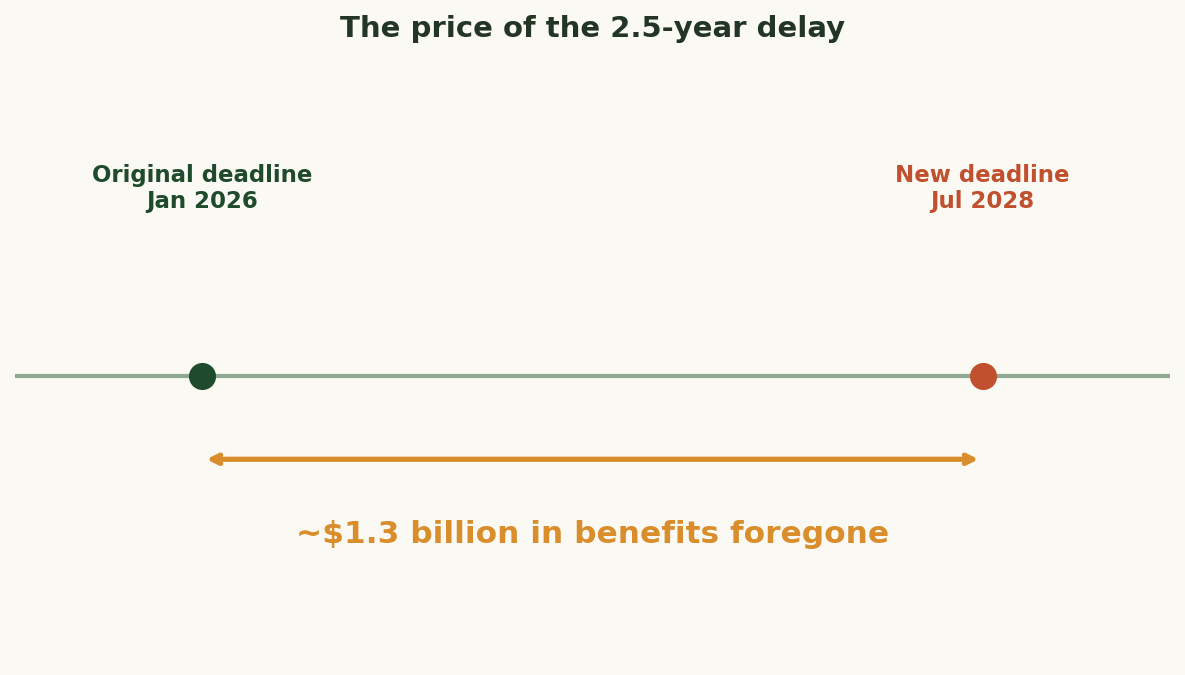
The delay happened for a real reason — the industry genuinely couldn't coordinate fast enough (the first-mile problem, where data breaks at the earliest handoffs). But the extension is not a reprieve. It's a countdown with a number attached. Every month the industry stays un-traceable is measurable risk the regulator has already priced.
What This Means for Operators
Strip away the government formatting, and three things fall out of this analysis that should reshape how any fresh-food business thinks about traceability:
It's an investment, not a cost. Even by the FDA's conservative model, the benefits outweigh the costs by hundreds of millions a year. Framing traceability purely as a compliance expense misreads the agency's own math.
Recall precision is where the money is. The single biggest lever an individual operator controls is how narrowly they can trace — the ability to recall a pallet instead of a product line. That's not marketing language; it's the benefit category the FDA scored.
The compliance cost is exactly what technology removes. The FDA breaks the cost of the rule into three buckets: capital investment, training, and recordkeeping. Those are precisely the burdens that modern, automated traceability systems are built to shrink — turning a manual, labor-heavy obligation into software that runs in the background.
The Bottom Line
For years, the case for traceability has rested on intuition: of course it's better to know where your food came from. What the FDA's analysis provides is something sturdier — a federally-modeled, dollar-denominated confirmation that traceability creates far more value than it costs, and that the value lives in speed and precision.
The mandate set the floor. The economics set the opportunity. The operators who treat the next two years as a runway — rather than a reprieve — are the ones who'll be capturing that value while everyone else is still scrambling to catch up.
ProduceX turns the two things the FDA says traceability is worth — speed of trace and recall precision — into everyday operational reality. Lot-level visibility that traces in minutes, not days, and surgical recalls instead of blanket ones — with the capital, training, and recordkeeping burden absorbed by software. See how ProduceX helps you capture the value the mandate is chasing.